
The Perfect Guide to the UKG Syllabus 2026 in India: CBSE vs ICSE Comparison
The Ultimate Guide to the UKG Syllabus 2026 in India: A Parent’s Blueprint
The transition from Lower Kindergarten (LKG) to Upper Kindergarten (UKG) is a monumental step in a child’s early education. In the Indian education system, UKG acts as the final preparatory bridge before a student enters primary school (Class 1). Understanding the UKG syllabus 2026 is essential for parents who want to actively participate in their child’s cognitive, social, and academic development.
With the introduction of the National Education Policy (NEP) 2020, early childhood care and education (ECCE) have taken center stage in India. The curriculum has shifted from rote memorization to experiential and play-based learning. This comprehensive guide breaks down the complete UKG syllabus, compares the two major educational boards (CBSE and ICSE), and provides actionable tips for parents.
Introduction to Upper Kindergarten (UKG) in India
Upper Kindergarten is designed for children typically aged between 4.5 to 5.5 years. At this age, a child’s brain is highly receptive to language acquisition, logical reasoning, and social conditioning. The UKG syllabus is carefully curated to transform the playful curiosity of a toddler into the structured learning habits required for formal schooling.
Why is the UKG Year Crucial for Your Child?
The UKG curriculum is not just about learning alphabets and numbers; it is about building a robust foundation. During this year, children transition from recognizing single letters to reading short words, and from counting objects to understanding basic mathematical operations. It sets the tone for their entire academic journey.
Understanding the Core Subjects in the UKG Syllabus 2026
While schools may tweak their specific lesson plans, the overarching structure of the UKG syllabus remains consistent across the Indian education system. It is broadly divided into four main subjects: English, Mathematics, General Awareness (EVS), and a Second Language (usually Hindi or the regional state language).
English (Language and Phonics)
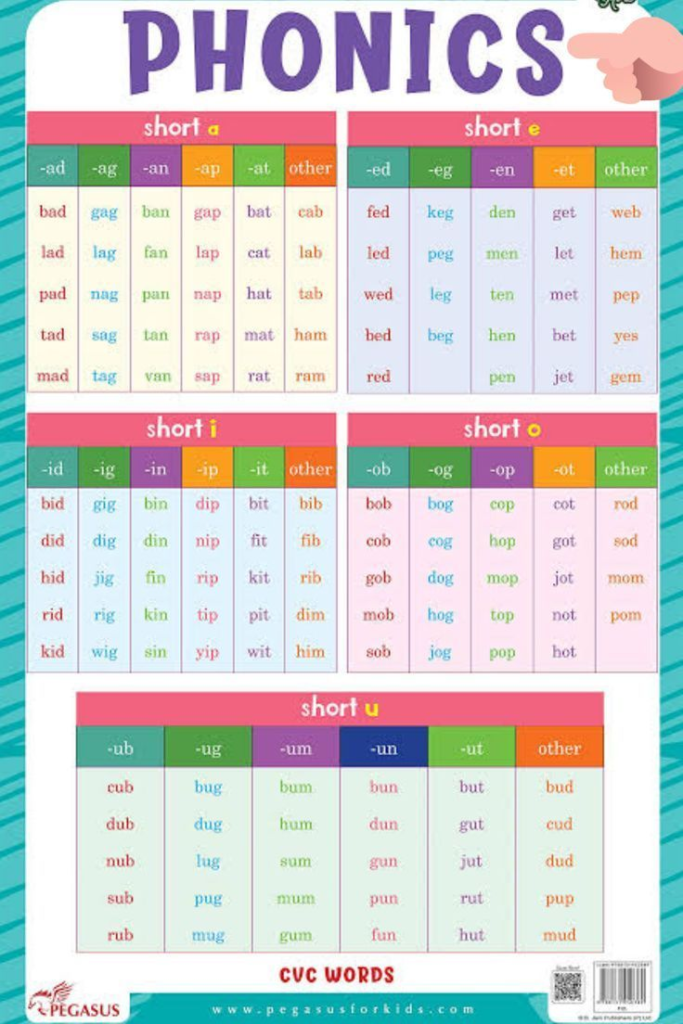
The English syllabus in UKG focuses on transitioning students from basic alphabet recognition to reading and constructing simple sentences. Phonics plays a massive role in this stage.
Reading and Writing Skills
Writing takes a structured form in UKG. Children are taught to control their pencil grip and write within the lines.
- Vowels and Consonants: Identification and differentiation.
- Phonics: Sounding out letters and blending them (e.g., /c/ /a/ /t/ makes cat).
- CVC Words: Reading and writing Consonant-Vowel-Consonant words (bat, red, pig, hop, sun).
- Sight Words: Memorizing common words that do not follow phonetic rules (the, is, you, are, to).
- Articles: Basic introduction to using ‘a’ and ‘an’.
- Positions: Words like in, on, under, behind.
Oral Communication
Teachers focus heavily on spoken English, encouraging children to express their needs, narrate short stories, and recite rhymes with proper intonation.
Mathematics (Numbers and Logic)
Math in UKG moves beyond simple counting. It introduces the foundational concepts of quantitative reasoning and spatial awareness.
Pre-Math Concepts
Before diving into numbers, children must understand relative concepts.
- Big/Small, Tall/Short, Heavy/Light.
- More/Less, Thick/Thin.
- Left/Right, Up/Down.
Number Recognition and Operations
The quantitative aspect of the UKG syllabus is thorough and structured.
- Numbers 1 to 100: Writing and reciting numbers sequentially.
- Backward Counting: Counting backward from 50 to 1 or 20 to 1.
- Skip Counting: Counting by 2s, 5s, and 10s.
- Number Names: Learning to spell numbers from 1 to 50.
- Basic Operations: Introduction to single-digit addition and subtraction using objects and pictures.
- Shapes and Colors: Identifying 2D shapes (circle, square, rectangle, triangle) and an introduction to simple 3D shapes (sphere, cube).
General Awareness (Environmental Science – EVS)
EVS is where children learn about the world around them. It builds their general knowledge and teaches them how to interact with their environment responsibly.
Self, Family, and Surroundings
This section helps the child place themselves within the context of the world.
- My Body: Identifying external body parts and their functions (sense organs).
- My Family: Understanding family trees, relations, and the home environment.
- Seasons: Recognizing summer, winter, monsoon, and spring.
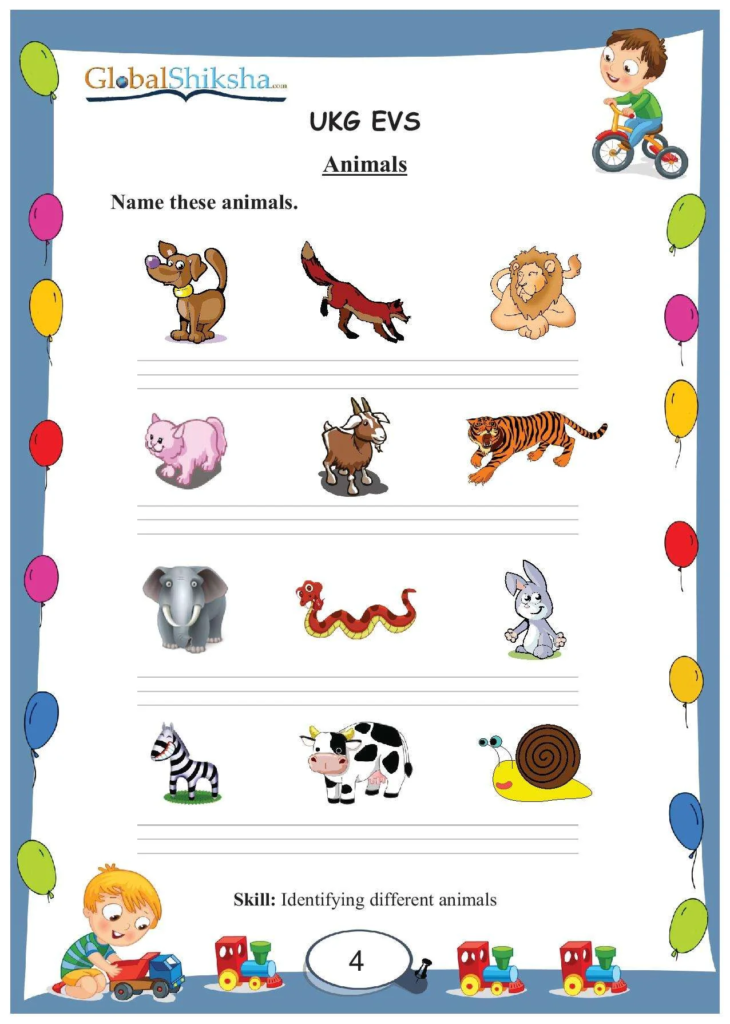
- Animals: Categorizing wild animals, domestic animals, water animals, and birds. Understanding animal homes and their young ones.
- Transport: Learning about land, water, and air transport.
- Community Helpers: Recognizing the roles of doctors, teachers, police officers, and firefighters.
Hindi / Regional Language (Second Language)
In the Indian education system, a second language is introduced early. For a vast majority of schools, this is Hindi.
- Swar (Vowels): अ to अः recognition, pronunciation, and writing.
- Vyanjan (Consonants): क to ज्ञ recognition, pronunciation, and writing.
- Two-letter Words: Reading and writing simple words without matras (e.g., जल, फल, घर).
- Rhymes and Stories: Reciting short Hindi poems (Kavita) to improve pronunciation and vocabulary.
CBSE vs. ICSE: Which Board is Best for UKG?
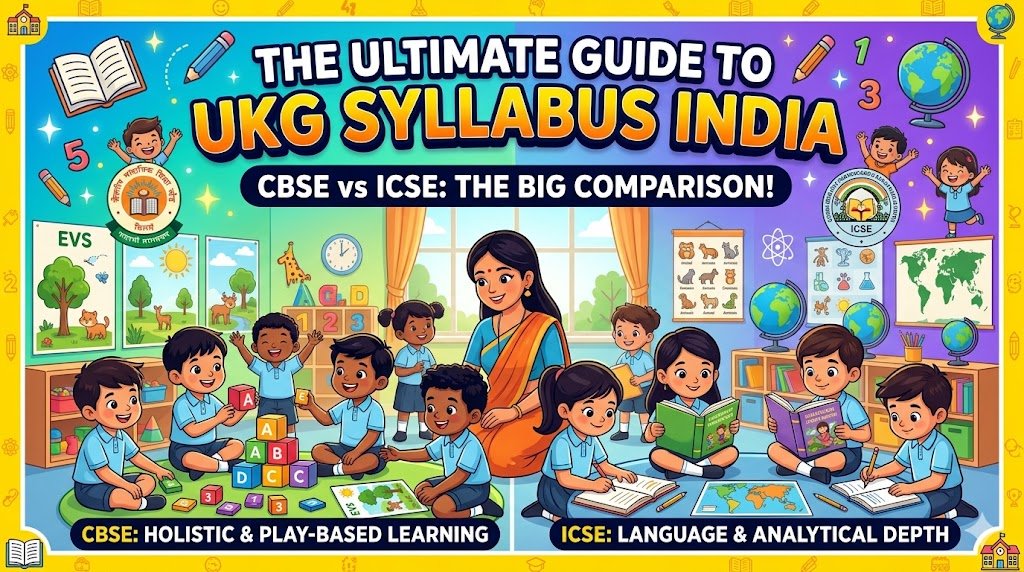
One of the most common dilemmas Indian parents face is choosing the right educational board for their child. While both the Central Board of Secondary Education (CBSE) and the Indian Certificate of Secondary Education (ICSE) offer robust frameworks, their approaches to early childhood education differ significantly.
The CBSE UKG Syllabus Approach
The CBSE board closely follows the guidelines set by the National Council of Educational Research and Training (NCERT) and the recent mandates of the NEP 2020. The approach is highly holistic, focusing on reducing academic pressure and promoting joyful learning.
Focus Areas in CBSE
CBSE prioritizes foundational literacy and numeracy (FLN) through experiential learning. The syllabus is designed to be highly accessible and uniformly structured across the country.
Play-Way Methodology
CBSE schools heavily employ the play-way method in UKG. Learning is integrated with activities, games, and storytelling. The academic burden is kept intentionally light to ensure the child does not feel overwhelmed. Science and EVS are taught through nature walks and practical demonstrations rather than textbook memorization.
The ICSE UKG Syllabus Approach
The ICSE board is known for its comprehensive, detailed, and slightly more rigorous curriculum. The Council for the Indian School Certificate Examinations (CISCE) designs a syllabus that focuses heavily on language proficiency and analytical skills right from the foundational years.
Focus Areas in ICSE
ICSE places a strong emphasis on English literature, complex vocabulary, and thematic learning. Children in ICSE UKG are often exposed to reading paragraphs and understanding complex environmental concepts earlier than their peers.
Language and Analytical Depth
The ICSE syllabus is highly detailed. For example, while learning about “Animals” in EVS, an ICSE curriculum might dive deeper into the specific diets of animals (herbivores vs. carnivores) and intricate details of their habitats, whereas CBSE might stick to basic identification. The English curriculum includes advanced phonetics and early grammar rules.
Key Differences: CBSE vs. ICSE (Comparison)
| Feature | CBSE UKG Syllabus | ICSE UKG Syllabus |
|---|---|---|
| Primary Focus | Holistic development, foundational literacy, and numeracy. | Language proficiency, analytical skills, and detailed knowledge. |
| English Language | Focuses on basic phonics, sight words, and simple sentence construction. | Focuses on advanced vocabulary, complex phonics, and early reading comprehension. |
| Curriculum Volume | Lighter, designed to minimize stress and promote play-based learning. | Heavier and more extensive, requiring more focused study time. |
| EVS/Science | Basic environmental awareness taught through observation. | In-depth thematic topics with more complex classifications. |
| Assessment Style | Continuous, informal, and activity-based observation. | Structured assessments, though still relatively informal at this age. |
| Transition to Class 1 | Smooth, steady progression. | Requires a strong academic baseline; highly rigorous. |
Export to Sheets
Extracurricular and Cognitive Development Activities
Academic subjects are only one half of the UKG syllabus. The other half is dedicated to physical, emotional, and cognitive development. Schools incorporate various activities to ensure well-rounded growth.
Motor Skills Enhancement
Developing motor skills is vital for physical coordination and cognitive processing. The syllabus categorizes this into fine and gross motor skills.
Fine Motor Skills
Fine motor skills involve the use of small muscles in the hands and fingers. These are crucial for developing good handwriting.
Activities for Fine Motor Growth
Schools use targeted activities to strengthen hand-eye coordination.
Crafting and Coloring
Activities like paper tearing, origami, clay modeling, buttoning shirts, stringing beads, and coloring within specific boundaries are staple parts of the UKG routine. These micro-movements train the brain-to-hand signaling pathways.
Gross Motor Skills
Gross motor skills involve the large muscles of the body, aiding in balance and overall physical fitness. The syllabus includes outdoor playtime, running, jumping on trampolines, balancing on beams, and basic yoga or PT (Physical Training) exercises.
Tips for Parents to Support UKG Learning at Home
A child’s education is a collaborative effort between the school and the parents. Here is how you can support your child’s UKG syllabus at home without making it feel like a chore:
- Read Together Daily: Make bedtime stories a non-negotiable habit. Point to the words as you read to help them recognize sight words and understand sentence structure.
- Incorporate Math in Daily Life: Ask your child to count the number of apples in the basket, sort their toys by color, or point out the shapes of various household items (e.g., a rectangular door, a circular plate).
- Encourage Phonics over Rote Learning: If they struggle with a word, encourage them to sound it out rather than just memorizing it.
- Limit Passive Screen Time: Replace passive cartoon watching with interactive, educational games that promote problem-solving and phonics practice.
- Foster Independence: Encourage them to pack their own school bag, tie their shoelaces, and eat independently. This builds confidence that translates directly into the classroom.
Conclusion
The UKG syllabus is a beautifully structured pathway that guides children from the playful world of early childhood into the disciplined environment of formal education. Whether you choose the play-way, holistic approach of the CBSE board or the detailed, language-rich environment of the ICSE board, the core objective remains the same: to build a confident, curious, and capable learner.
By understanding the intricacies of the English, Math, and EVS curriculums, parents can create a supportive home environment that perfectly complements what the child learns in school. Remember, at the UKG level, the focus should always be on making learning a joyous adventure rather than a stressful obligation.
Frequently Asked Questions (FAQs) About UKG Syllabus
Q1: What is the right age for a child to be admitted to UKG in India? According to the latest NEP 2020 guidelines and the mandates of most Indian states, a child should ideally be between 4.5 to 5.5 years old when entering UKG.
Q2: Should I force my child to write in cursive during UKG? No. While some ICSE schools introduce cursive strokes late in UKG, the primary focus should be on clear print handwriting, pencil control, and correct letter formation. Forcing cursive too early can frustrate the child.
Q3: How much homework is appropriate for a UKG student? At the UKG level, homework should be minimal. A maximum of 15 to 20 minutes of revision, such as practicing a few lines of writing, reading a short phonics book, or a fun math worksheet, is more than sufficient.
Q4: Is it necessary for a child to know Hindi before entering UKG? It is not mandatory, but basic oral exposure helps. The UKG syllabus typically starts with the absolute basics of Hindi (Swar and Vyanjan), assuming the child is learning to read and write it for the first time.
Q5: Which board is easier for a child transferring from another state, CBSE or ICSE? CBSE is generally considered more adaptable for transferring students due to its uniform curriculum across India and slightly less rigorous early academic pressure compared to ICSE.