
9 Powerful Types of Play Based Learning Every Parent Must Know..
Types of Play Based Learning: A Complete Guide for Early Childhood Education
Play is not just fun for children—it is the foundation of how young minds grow, explore, and understand the world. In early childhood education, play based learning is one of the most effective and research-backed teaching approaches. It helps children develop cognitive, emotional, social, physical, and language skills naturally.
In this article, we will explore the different types of play based learning, why they matter, and how they support a child’s overall development. Whether you are a parent, educator, or school owner, understanding these play types will help you appreciate the true value of play in learning.
What Is Play Based Learning?
Play based learning is an educational approach where children learn through play activities that are meaningful, engaging, and developmentally appropriate. Instead of formal instruction, children explore concepts through hands-on experiences, imagination, and interaction.
This method is widely used in play schools, preschools, and early learning centers because it matches how young children naturally learn best.
Why Play Based Learning Is Important in Early Childhood
Before understanding the types, it is important to know why play-based learning is essential:
- Encourages curiosity and creativity
- Builds social and emotional skills
- Supports language and communication development
- Improves problem-solving and critical thinking
- Enhances physical and motor skills
- Makes learning joyful and stress-free
Now, let’s explore the main types of play-based learning in detail.
Types of Play Based Learning
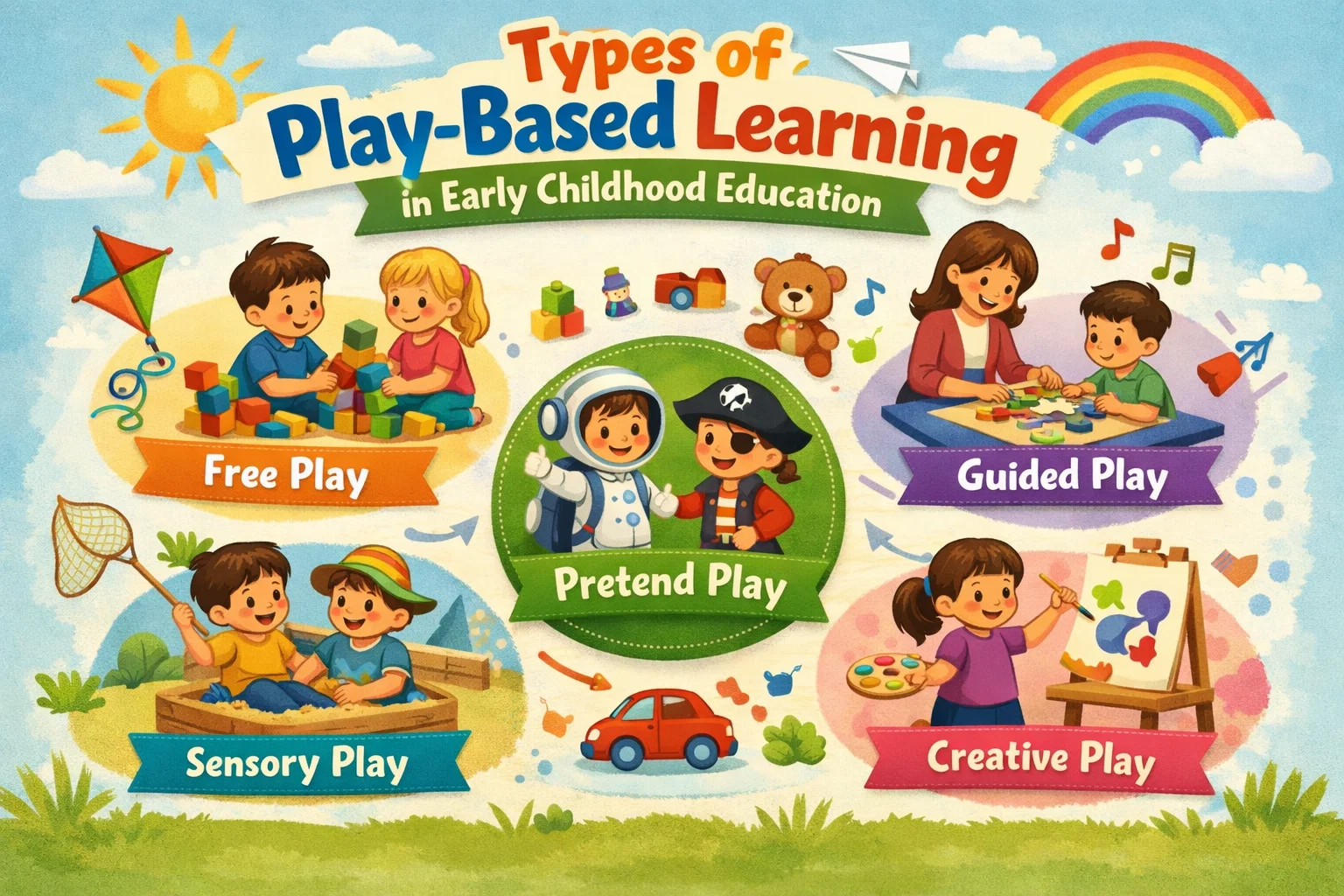
1. Free Play
What Is Free Play?
Free play is unstructured play where children choose what to play, how to play, and with whom to play. There are no fixed rules or adult instructions.
Examples of Free Play:
- Playing with blocks
- Drawing or coloring freely
- Pretend play with toys
- Outdoor play without rules
Benefits of Free Play:
- Builds independence and decision-making
- Encourages creativity and imagination
- Helps children express emotions
- Improves self-confidence
Free play allows children to explore their interests at their own pace, making it one of the most powerful forms of learning.

2. Guided Play
What Is Guided Play?
Guided play is a balance between free play and structured learning. Here, teachers or caregivers guide children gently toward learning goals while still allowing freedom.
Examples of Guided Play:
- Building shapes with blocks under teacher guidance
- Sorting colors with prompts
- Counting toys during play
Benefits of Guided Play:
- Supports early math and literacy skills
- Keeps learning playful yet purposeful
- Encourages interaction between teacher and child
Guided play is especially effective in preschools where learning outcomes are planned but delivered in a fun way.
3. Physical Play
What Is Physical Play?
Physical play involves activities that develop gross and fine motor skills using body movement.
Examples of Physical Play:
- Running, jumping, climbing
- Dancing and action songs
- Ball games
- Obstacle courses
Benefits of Physical Play:
- Strengthens muscles and coordination
- Improves balance and body control
- Promotes healthy growth
- Boosts energy and focus
Physical play is essential for children’s physical health and also supports brain development.

4. Constructive Play
What Is Constructive Play?
In constructive play, children create or build something using materials like blocks, clay, or puzzles.
Examples of Constructive Play:
- Building towers with blocks
- Making shapes with clay
- Completing puzzles
- Craft and art activities
Benefits of Constructive Play:
- Enhances problem-solving skills
- Develops spatial awareness
- Improves hand-eye coordination
- Encourages patience and planning
This type of play helps children understand cause and effect while expressing creativity.
5. Pretend Play (Dramatic Play)
What Is Pretend Play?
Pretend play involves imagination, role-playing, and storytelling. Children act out real-life or imaginary situations.
Examples of Pretend Play:
- Playing house or school
- Acting as doctors or shopkeepers
- Using costumes and props
Benefits of Pretend Play:
- Builds language and communication skills
- Enhances social understanding
- Encourages empathy and emotional intelligence
- Develops storytelling abilities
Pretend play helps children make sense of the world around them.

6. Social Play
What Is Social Play?
Social play occurs when children play together, learning how to interact with peers.
Types of Social Play:
- Cooperative play
- Group games
- Team activities
Benefits of Social Play:
- Improves sharing and turn-taking
- Builds friendships
- Develops conflict-resolution skills
- Enhances teamwork and cooperation
Social play is crucial for emotional and social development in early childhood.
7. Sensory Play
What Is Sensory Play?
Sensory play engages a child’s five senses—touch, sight, sound, smell, and taste.
Examples of Sensory Play:
- Playing with sand or water
- Sensory bins
- Finger painting
- Playing with textured materials
Benefits of Sensory Play:
- Supports brain development
- Improves sensory processing
- Enhances focus and calmness
- Encourages exploration
Sensory play is especially helpful for toddlers and children with special learning needs.

8. Creative Play
What Is Creative Play?
Creative play allows children to express themselves through art, music, and movement.
Examples of Creative Play:
- Drawing and painting
- Singing and dancing
- Music and rhythm games
Benefits of Creative Play:
- Boosts self-expression
- Encourages imagination
- Builds emotional confidence
- Develops fine motor skills
Creative play helps children communicate feelings that they may not yet express in words.
9. Language and Literacy Play
What Is Language Play?
Language play focuses on developing communication and early literacy skills through fun activities.
Examples of Language Play:
- Storytelling
- Rhymes and songs
- Puppet shows
- Alphabet games
Benefits of Language Play:
- Improves vocabulary
- Enhances listening skills
- Builds early reading readiness
- Encourages confident communication
This type of play lays a strong foundation for future academic success.
How Play Based Learning Supports Holistic Development
Play-based learning does not focus on one skill—it supports whole-child development, including:
- Cognitive development
- Physical growth
- Emotional well-being
- Social skills
- Language and communication
This holistic approach makes learning enjoyable and meaningful.
FOR MORE VISIT MINNIELAND THE GLOBAL SCHOOL
Conclusion
Understanding the types of play based learning helps parents and educators recognize that play is not a distraction—it is learning itself. Each type of play plays a unique role in shaping a child’s mind, body, and emotions.
Play-based learning creates confident, curious, and capable learners who enjoy the process of discovering the world. A good play school blends these play types to offer children a balanced, joyful, and enriching learning experience.
Frequently Asked Questions (FAQs)
1. What is the best type of play based learning?
There is no single “best” type. A combination of free play, guided play, physical play, and creative play works best for overall development.
2. Is play based learning effective for academics?
Yes. Play-based learning builds strong foundations for math, language, and problem-solving skills.
3. At what age should play based learning start?
Play-based learning can begin as early as toddler age (1.5–2 years) and continue through preschool.
4. How do play schools use play based learning?
Play schools design activities that combine fun with learning goals, ensuring children learn naturally through play.
5. Can parents use play based learning at home?
Absolutely. Simple activities like storytelling, block play, and role-playing are effective play-based learning methods at home.
8 Toddler Activities At Home For Growth & Brain Development
January 1, 2026[…] READ MORE – 9 Powerful Types of Play Based Learning Every Parent Must Know.. […]
5 Best Early Learning Curriculum Every Parent Must Know
January 31, 2026[…] ALSO READ – 9 Powerful Types of Play Based Learning Every Parent Must Know.. […]